
今日看世界
金“蒜”盘闯出致富路_我的网站

A |
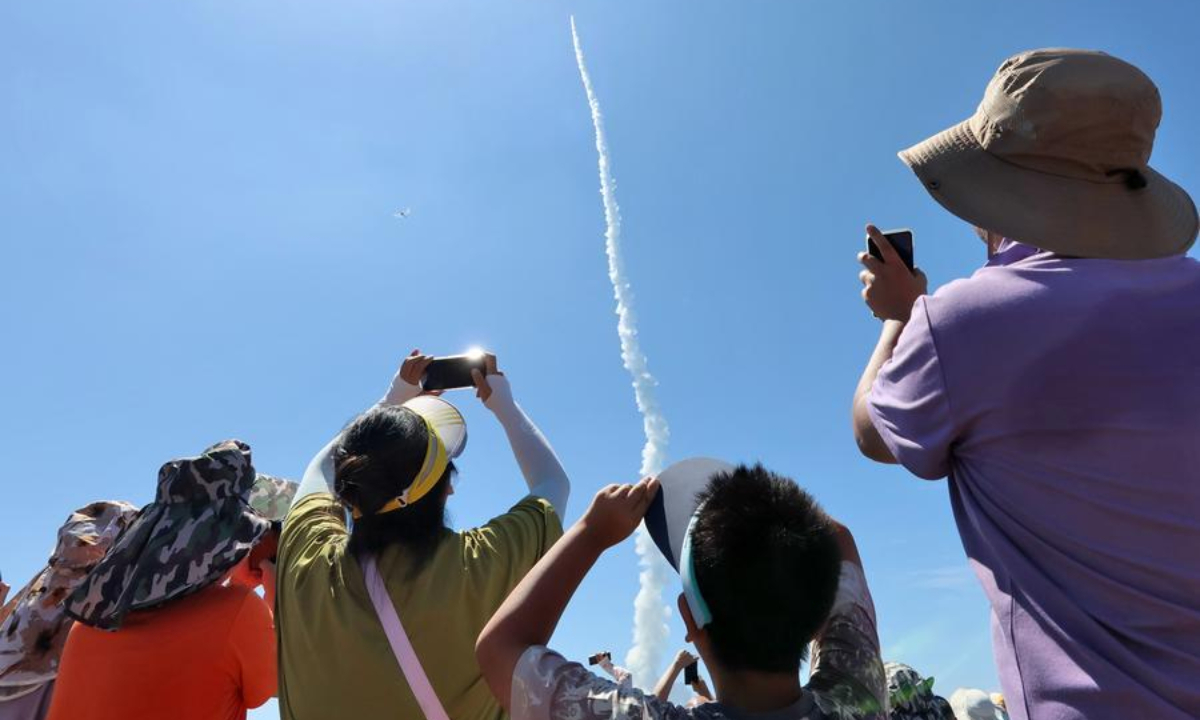
A burst of flame lit the morning sky over waters off Haiyang in east China's Shandong Province on Wednesday as a Smart Dragon-3 (SD-3) carrier rocket lifted off, drawing cheers from viewing sites along the coast.
Among the spectators were international students studying aerospace subjects in China. Aithana Perez, a Venezuelan aeronautical engineer studying space project management at Hangzhou Innovation Institute of Beihang University, said she and her classmates were excited because their studies involved spacecraft launch, design and operation.
For Marwane Oufrid, a 23-year-old Moroccan student in the same institute specializing in microsatellite technology, it was the first time he had watched a rocket launch in person.
The rocket blasted off at 10:38 a.m. (Beijing Time), delivering the Oriental Smart Eye hyperspectral satellites 01 and 02 into planned orbit.
In their respective cooperation projects with Indonesia and Uzbekistan, Satellite 01 is also known as Lampung-1 and Satellite 02 as Samarkand-2028.
Once in orbit, the satellites turned their attention back toward Earth. Lampung-1 is expected to monitor crop growth and disaster risks in Indonesia, while Samarkand-2028 is designed to support cotton cultivation and other land-monitoring applications in Uzbekistan.
Ordinary optical cameras mainly record the shape and color of objects. Hyperspectral imagers record a detailed spectrum for each image pixel, creating "spectral fingerprints" that can help determine the condition and composition of vegetation, water, soil and minerals.
These spectral "eyes" are paired with onboard AI computing modules capable of delivering up to 400 trillion operations per second. Instead of sending every raw image to the ground, the satellites can identify features, detect anomalies and extract useful information in orbit, potentially shortening delivery time from days to minutes.
Song Bingchen, co-founder of the Star.ai Spatio-temporal Intelligence Technology Co., Ltd., whose subsidiary STAR.VISION developed the satellites, compared the system to moving an AI inference platform from the ground into space.
"It changes the traditional model from transmitting images to transmitting results," Song said.
"Our satellite constellations are open to the world," Song noted, adding that the company welcomes international partners to jointly invest in, build and use the satellite networks.
In Indonesia, Lampung-1's planned applications are centered in Lampung Province on the island of Sumatra. Agriculture, forestry and fisheries accounted for 28.38 percent of the provincial economy in the third quarter of 2025. The satellite will also support marine resource management, environmental monitoring and disaster response.
Rahmat Mirzani Djausal, governor of Indonesia's Lampung Province, described the successful launch as a "historic moment" for the province.
"Cooperation with China on this satellite project is of historic and strategic significance," he said. "It marks the beginning of Lampung's transformation into a technologically advanced province."
The governor commended China's openness in sharing space technology and its commitment to long-term cooperation.
"China understands that any problems we face on one side of the world will ultimately impact the other side. Therefore, it is essential to empower regions that are left behind to make the world ultimately a better place," he said.
This cooperation also extends to people. Lampung is preparing to send over 100 young professionals to China for training in remote sensing and satellite communications, with the goal of building local capacity in satellite operation, data processing and spatial analysis.
In Uzbekistan, the applications center on cotton, grain and vegetation monitoring. Samarkand-2028 is designed to follow cotton cultivation from sowing to harvesting, while Uzbekcosmos has said hyperspectral data will also be used to produce national cotton and wheat maps.
Mukhiddin Ibragimov, deputy director of the Uzbekcosmos Agency, described the project as one of the largest international space projects in Uzbekistan's history and a milestone in its national space program.
He called the launch "a great occasion," saying it was the first time Uzbekistan had participated in an international space mission of such scale.
Ibragimov said Uzbekistan sent a technical team to China early in the project and formed a working group with Chinese specialists to develop an AI model for onboard data analysis. This model focuses on crop classification, including cotton verification, grain identification and vegetation monitoring.
The resulting data will support agriculture, water resource management, environmental protection and emergency monitoring, among other applications, he revealed.
Ibragimov said no single country can handle all space-related tasks alone.
"We believe that partnership brings value. We see that China is doing the same thing," he said, adding that Uzbekistan is exploring further satellite cooperation with China.
The projects offer a commercial example of the approach set out in China's 2021 space white paper, which called for international cooperation based on equality, mutual benefit, peaceful utilization and inclusive development.
Back in Haiyang, Oufrid said projects of this kind could give more countries an opportunity to participate in the space sector. He expressed the hope to see such cooperation happen more often and "maybe someday with Morocco as well."
。

B | 《日报》全媒体记者 张宝程 3个月的生长期到了,6月11日一大早,李海山找来30多名帮手,到自家地块收获独头蒜。

C | “今年长势不错,估计一亩地能产两千多斤,市场行情也好,每斤6元左右,每亩毛钱能卖1.3万元,真是咱老百姓致富的金‘蒜’盘啊。” 绥中县塔山屯镇大施宝村地理位置优越,气候、土壤等均适合种植独头蒜。像其他种植户一样,依托国家的好政策,在当地政府大力扶持下,10余年来,李海山在种植独头蒜的道路上踏实前进。“一开始是几亩、十几亩,到现在70亩。

D | 这项产业让我尝到了甜头,家里以前破旧的房子变成现在的二层小楼,车也不缺,小日子红红火火。” 别看李海山说得轻巧,其实,在生产经营过程中,他与家人花费了很多心思和辛苦。每年的9月份,从山东采购独头蒜种子,然后放在院子里的通风、阴凉处。到了寒冷时节,还得拿到屋子里,温度不能太高。“种子很娇气,存放时温度不能过高或过低,否则影响质量,来年开春种植后影响出苗率及产量。” 每年的3月初,开始种植独头蒜。

E | 十余天里,李海山与家人非常忙,几乎每天都吃喝在地里,生怕耽搁了农时。种子下到地里,他还时时观察水分大小、温度高低,目的是让独头蒜茁壮成长。

F | “功夫不负有心人,今年我家能产十五六万斤独头蒜,产值近100万元,纯利润将近40万元。

G | ” 种植、管理、收获等方面均科学规范、合理有序,当地的独头蒜个头大、颜色好、口感佳,十余年来,名声在外。每当收获季来临,种植户通过自身的人脉资源或农村经纪人,联系上四川、云南、重庆等地的客商,对方开着大货车及时赶过来,种植户不用将独头蒜运回家,在田间地头就将产品卖掉,省去了脱水、储存等环节。 据大施宝村村支书赵刚介绍,村民的市场嗅觉非常敏锐,加上村干部积极宣讲政策、大力帮扶、拓展市场,村民种植独头蒜的热情一年比一年高。“今年村里种植1000余亩独头蒜,村民还在临近村子承包了将近4000亩,共种植5000亩左右。产值能达到6000万元,纯利润2000余万元。” 为了让农业产业进一步“身价看涨”,塔山屯镇镇政府积极与有关部门联系,批复了几块大型晾晒场地,便于种植户晾晒独头蒜。该镇镇长孙雪说,受市场行情波动影响,有些种植户收获完不立即售卖,而是晾晒后储存在恒温库里。等到“十一”或年前年后卖,每斤独头蒜能达到八九元钱,进一步增加了种植户收入。 “政府和广大种植户始终同频共振,在不断优化营商环境的同时,积极做好助手、帮手、抓手,‘多面手’的正向形象深入人心,加上他们科学种植、管理精细,致富的道路才能越走越宽阔。

H | ”孙雪说。

I |
Current article:http://h3ry.cuntoujuefourantapai.cfd/n5a/88q1o.html
Published on:14:47:57


